



Gardens, Not Vineyards: The Quiet Radicalism of Elise Dechannes
As one chapter closes in Les Riceys, Elise Dechannes reimagines what a vineyard—and a life in wine—can be.
By Ryan Lim
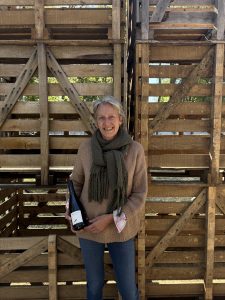
When we arrived to see Elise Dechannes in Les Riceys, we were greeted with a mostly empty cellar. Much of the equipment had already been sold off to friends nearby in the Aube — to vignerons like Ruppert Leroy, Marie & Olivier Horiot, and Champagne Fleury — signaling quiet traces of a chapter coming to an end; yet Elise herself seemed lighter than before, almost relieved, though perhaps more militant than ever. Full of conviction, she spoke with the energy of someone no longer trying to preserve a place within the system, but instead, finally free to question it openly.
2023 was the last vintage Elise vinified from her 4.5 hectares of vines in Les Riceys, parcels she often refers to not as vineyards, but as her gardens. For years, those vines had only been treated with biodynamic preparations — 500, 501, and a series of herbal tisanes made from plants like nettle, rosemary, oregano, rose, borage, bay leaf — each chosen for balance, resistance, or vitality. Most people would likely be surprised to learn that Elise never used electrically powered machines in her cellar. Even the biodynamic preparations themselves were dynamized entirely by hand, without mechanical mixers, Elise preferring to plunge her arms directly into the liquid, stirring slowly and deliberately, believing intention itself mattered. She spoke often about energy, about refusing to enter the cellar angry, refusing to taste absentmindedly, refusing to work when her heart was elsewhere. For Elise, wine was never simply a product of agriculture, but a reflection of presence. Even the labels themselves were applied by hand. Intention, in one form or another, seemed embedded everywhere.
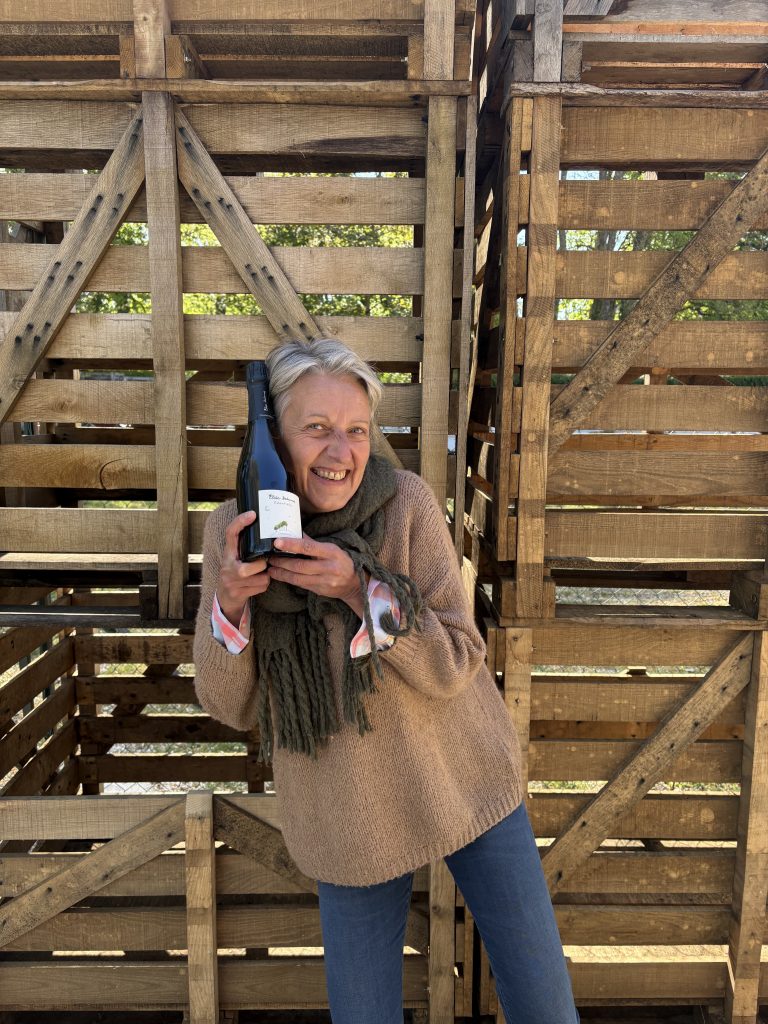
Elise Dechannes — Photo Credit: Fat Cork
Her approach in the vines followed the same philosophy. Over the years she progressively eliminated copper treatments across much of the estate, choosing instead to rely on herbal preparations and observation. The wines themselves were always bottled with essentially no additions — zero dosage, virtually no sulfur, no chemicals, and no corrections. There was never any desire to dominate the wine or force it into shape. Elise often spoke about accompanying the vine rather than controlling it, listening over intervening. In many ways, her wines felt like extensions of that exact philosophy: intensely alive, deeply textural Champagnes that somehow carried both tension and softness at once.
2024, however, brought no harvest. Like many growers across the Aube and Chablis, Elise watched the season unravel under relentless mildew pressure, compounded by frost and rain. Yet her reflections on the vintage were less about catastrophe than perspective. She pointed out that many neighboring growers who treated aggressively throughout the season — repeatedly spraying against mildew with systemic products and chemical treatments — still harvested only tiny quantities, in some cases, too little fruit even to justify running a press. For Elise, this revealed something larger about the relationship between farming and modern agriculture. We ask vines, she said, to exist in permanent productivity, to remain healthy and generous every single year, with no room for weakness, illness, exhaustion, or pause. Humans themselves cannot live that way. We fall sick, we become depleted, we pass through periods where we are not fully ourselves, yet we deny vines the same right to fragility. In trying to force perpetual abundance through endless treatments — all the various “-cides”: pesticides, herbicides, fungicides, insecticides — growers often find themselves trapped in an expensive cycle of damage and dependency, spending enormous sums protecting harvests that sometimes barely materialize anyway.
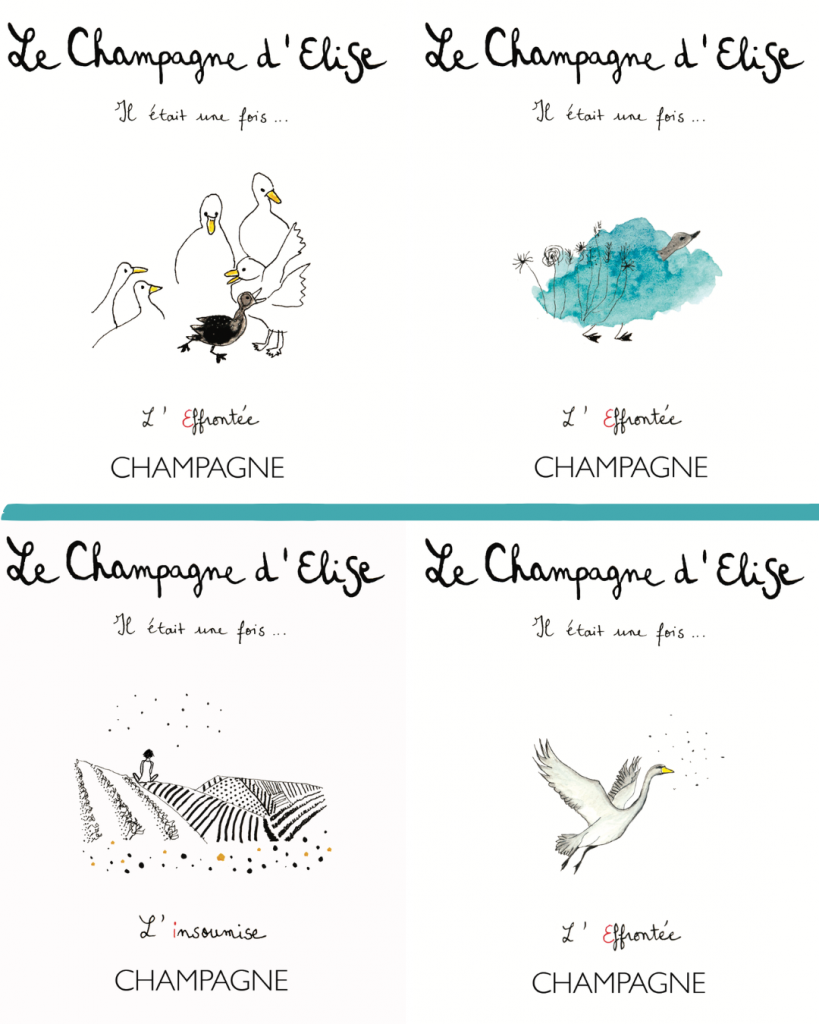
Elise’s beautiful new labels
That same sense of intention extends even into Elise’s labels. Her most uncompromising parcel in Nogent — a site farmed entirely without chemical treatments, something still almost unthinkable in Champagne — formed the heart of two cuvées, L’Effrontée (“the insolent”) and L’Insoumise (“the unconquered”), produced across nine single vintages beginning in 2013. The labels themselves feel almost autobiographical. L’Effrontée features Elise standing directly within her garden in Nogent, a quiet image of conviction and rootedness. L’Insoumise, meanwhile, depicts an awkward black duckling eventually transforming into a swan and flying away — escaping weight, expectation, and conformity. Seen together, the two labels feel less like branding than fragments of Elise herself: resistance, vulnerability, defiance, and ultimately, liberation.
A large portion of Elise’s vineyards — roughly 3.5 hectares — still belonged to her father, who wished for the land to remain within the family. The vines she had spent years cultivating biodynamically, the gardens she often spoke of almost as living companions, had once again been exposed to the full arsenal of chemical treatments she had spent her career rejecting. Elise’s choices, she says, cut her off from her family. The pain around the subject was palpable, though so was her clarity. Elise spoke not with bitterness so much as urgency, increasingly vocal — especially publicly and on social media — about what she sees as agriculture’s normalization of violence: an entire system built around products whose names themselves end in “-cide,” a language of eradication so deeply embedded within farming that most people no longer pause to question it.
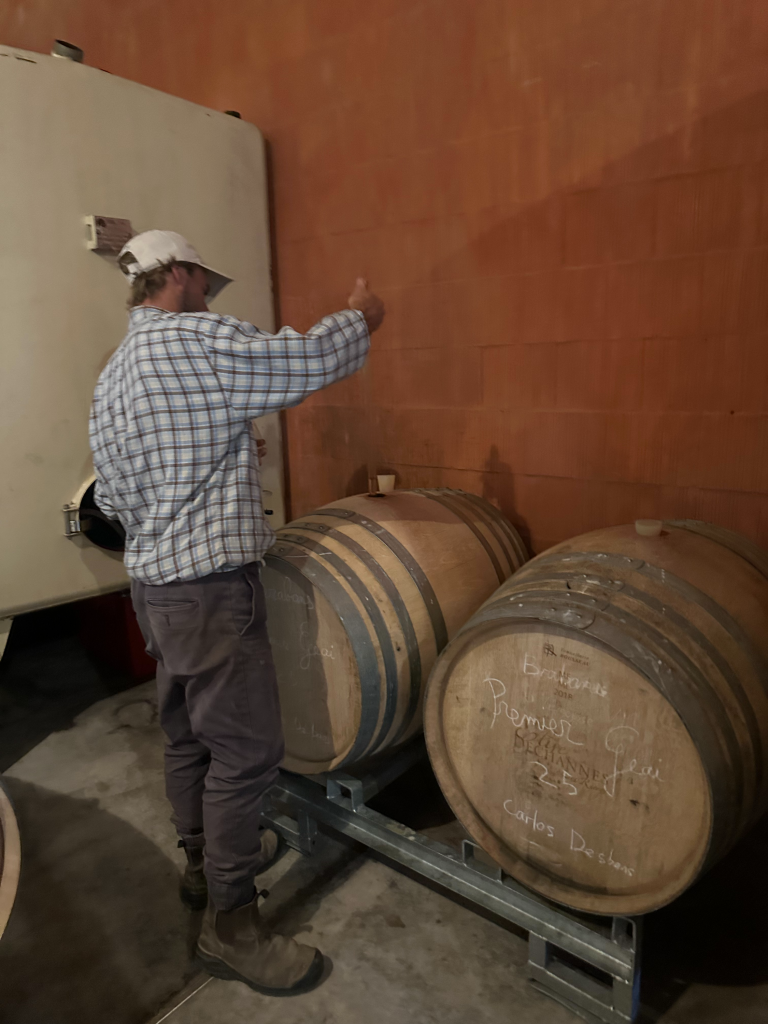
Carlos’ first vintage from the Nogent vineyard
Yet, amidst all of this, there remains a silver lining, a small continuation of her story. One hectare — her beloved parcel in Nogent — belonged directly to Elise, and those vines will continue under the care of a young winemaker named Carlos Desban, who has worked alongside Ruppert Leroy since the beginning. During harvest, Carlos also happened to be my roommate at Ruppert’s, and hearing him speak about taking over Elise’s vines carried an almost overwhelming sense of responsibility and reverence. For now, the wines are being pressed at Marie & Olivier Horiot’s winery and vinified / aged at Ruppert-Leroy while Carlos slowly builds his own project. We had the chance to taste the young wines together from barrel during our visit, and even in their infancy, there was already something unmistakably emotional about them — as though the energy of those vines had not disappeared, only changed hands. Elise seemed deeply relieved by this continuity, knowing at least part of her work, and part of her philosophy, would survive through someone younger, who genuinely understood what those vineyards had represented.
By the end of the visit, everyone seemed to leave slightly emotional — not only because the wines themselves were so profoundly moving, but because spending time with Elise inevitably forces reflection beyond wine. There is something disarming in the sincerity of her convictions, in the way she insists that intention still matters, that care matters, that the energy we bring into our work and into the world leaves traces behind whether we realize it or not. In a region increasingly shaped by climate anxiety, economic pressure, and technical solutions, Elise’s wines — and perhaps Elise herself — feel like reminders that another rhythm once existed, and perhaps still can.