



Métais-Nagata
Jean-Bernard Métais and Akito Métais-Nagata
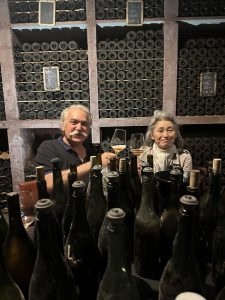
Jean-Bernard Métais is an unusual figure in French wine. Known internationally as a sculptor whose monumental works are exhibited from Le Mans to Seoul, he is also the 20th generation of his family to tend vineyards in Jasnières. In 1976, upon finishing his studies at Beaux-Arts de Paris, Jean-Bernard returned to Courdemanche and began vinifying the family vines — a lineage that dates back to the 16th century.
Jean-Bernard works alongside his wife, Keiko Nagata, and their children Akito and Sola Métais-Nagata, who have recently joined as the twenty-first generation. Together, the family runs the domaine in rare harmony, each bringing their own sensitivity to the wines. The Métais family story is remarkable even in a region steeped in history: in 1740, a royal decree from Louis XV granted them the right to export their wines. Most of the vineyards were planted in 1903 just after phylloxera, and now the average vine age is 80 years old.
At about 3 hectares, the vineyard is planted on a gentle, south-facing slope of soils scattered with pebbles of microcrystalline quartz. All vines are sculpted into gobelets, in the fashion preceding the trellis and mechanised labour. The parcels have never seen any herbicides, pesticides, or any products other than Bordeaux mixture.
The soil here is pure Jasnières — clay, limestone, and flint over chalky tuffeau — producing wines of tension, energy, and astonishing longevity. Nothing is rushed at Métais. Chenin and Pineau d’Aunis are harvested in five to six successive passes, and again sorted by maturity, allowing each berry to be picked at perfect maturity. In some years harvest can go on for two months, as the grapes ripen and increase in concentration on the vine.
Fermentation relies on indigenous yeasts. No products other than copper have ever been used in the vineyard — even in the 1960s, when chemicals swept through the Loire. Since 2015, the wines are bottled unfiltered, or at most gently filtered “à la plaque de coton,” as is done with fruit juice. Élevage is long by any standard; two years minimum for the Chenins, and between three and seven years for the grand liquoreux, which are only made two to three times per decade. Sulfur use is minimal, and reserved mainly for protecting barrels during élevage. The family cave itself is a living archive of viticulture. Bottles from 1834, 1870, 1921, and 1949 still rest here in perfect condition — silent witnesses to the extraordinary longevity of Métais wines.
They rest in the winery’s labyrinthine cellar, carved into the bedrock filled with a continuous reserve of the family’s work since the 18th century. Walking through the cellar, one sees the vineyard from the inside-out. The walls and ceiling are gorging with crystals of mineral clay and silica with fossils embedded on every surface.
The cellar also reflects the history of winemaking in France during modern times. For example, the larger chambers at the front, where the first wines were made, and some chambers carved entirely out of sight and out of reach, were where wine was hidden from the occupying forces during the First and Second World Wars.
Thus, the wines themselves form a dialogue between past and present. Silex and Éole, two dry Chenins, are crafted from three separate harvest passages, each bringing acidity, structure, or aromatic generosity to the final blend. Silex leans toward minerality and precision, while Éole offers more breadth and perfume. Hypérion, produced only three to five times per decade and aged for four to six years, is oxidative and ageworthy, carrying notes of baked apple, nuts, and spice.
At the pinnacle of the estate are the liquoreux wines, Passerillé and Grand Passerillé, produced only when nature allows. The Métais family’s connection to Château d’Yquem, begun in the 1930s when Jean-Bernard’s grandfather exchanged wines with the Sauternes estate, remains alive today. When Yquem’s maître de chai visited to taste Passerillé 2018, he was astonished by the purity and balance achieved with such low levels of sulfur. Jean-Bernard explains that the secret is to never force fermentation or dictate final sugar levels; the wines decide for themselves, which is why Grand Passerillé is made only twice per decade. This philosophy — allowing Chenin to find its own equilibrium rather than being pushed toward dryness — is a defining mark of Métais. In youth, the whites show a luminous purity with white peach and salt-etched precision. Across vintages, Chenin ranges from bone-dry to gently sweet when the year calls for it, always led by equilibrium rather than intervention.
For the reds, Pineau d’Aunis takes on new life in the Métais cellar. This is thanks in large part to Keiko Nataga, who fell in love with the variety’s haunting perfume that comes to life during fermentation, and she insisted that the family keep their Pineau d’Aunis vines when others might have uprooted them. To capture those subtle, fleeting aromatics that she smelled during élevage, she created the cuvée Callas — a lighter, fragrant expression that highlights delicate raspberry and white pepper. Vinified with 70% whole clusters layered “millefeuille-style” with destemmed grapes and always aged in old barrels, the Métais-Nagata wines remain expressive without ever tipping into heaviness. Two cuvées reveal different facets of the grape: Auguste, mostly destemmed with longer maceration, shows depth and savory spice; Callas, created by Keiko preserves the ethereal side of Pineau d’Aunis that first captured her imagination.
Even the barrels themselves carry a sense of place. New oak is sourced from the neighboring Forêt de Bercé, crafted in Burgundy, with only two new pièces introduced each vintage for the Chenins. No new oak is ever used for the reds. Production remains tiny, and the family’s cellar is guarded with strict rules: for every two bottles drunk, four must be replaced. Between 30–50% of each vintage never leaves the cave, ensuring continuity of the family’s archive. Of what is released, allocations are fiercely selective.
These special, small-production wines can be found at Arpège, Plaza Athénée, and Table Bruno Verjus in Paris. Beyond France, they are exported only to Japan and Korea — not from lack of demand, but because the Métais-Natata family carefully chooses whom to invite into their story.
Key information
Loire Valley
Courdemanche
3 hectares
Founded in 1976
The wines
Grand Passerillé Chenin Blanc Liquoreux
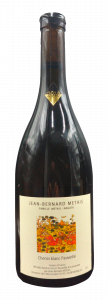
This exceptional cuvée is produced only in the very best 2 to 3 vintages in a given decade, composed of both late harvest and botrytized grapes rigorously selected from the vineyard at their highest possible levels of ripeness. After approximately ...
Passerillé Chenin Blanc Moelleux
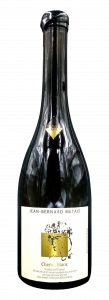
The Passerillé only appears every three to five years. Solely the best late harvest grapes are selected; the grapes may even remain on the vine into December. Generally following 27 to 28 months of oak ageing, the resulting wine is indulgent and lo...
Hyperion Chenin Blanc Sec-Tendre
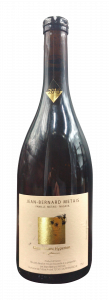
The Hypérion cuvée is the domaine’s distinctive oxidative expression of raisined Chenin Blanc, aged for 48-64 months in oak. Hyperion’s “soft-dry” palate gives a refined and timeless vignette of the Loire Valley.
Éole Chenin Blanc Sec
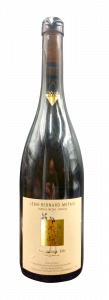
Giving a pensive insight into the generations that have shaped the domaine, Éole is aged on fine lees for up to two years: a signature that has been passed down from Jean-Bernard’s grandfather.
Silex Chenin Blanc Sec
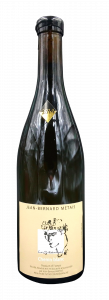
Produced just a handful of times per decade, Silex yields the driest and most precise interpretation of Chenin Blanc.
Pineau d’Aunis “Auguste”
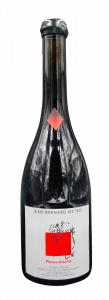
An homage cuvée named after Jean-Bernard’s grandfather, Auguste’s maceration time can extend to twelve days and age on lees for up to two years. The bottle unveils spicy and fruity notes, as well as unbroken practices handed down from one generatio...
Pineau d’Aunis “Callas”
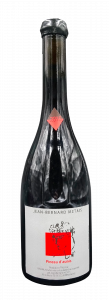
Keiko captures the fleeting aromatics of Pineau d’Aunis in Callas; the grapes are fully destemmed and macerated for up to eight days, retaining a lighter, more fragrant expression.
Tête à Tête Bulles Blanc
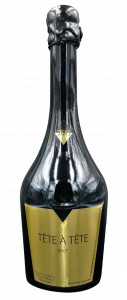
Meaning ‘head to head’ in English, this sparkling Chenin Blanc is produced by successive harvests in the vineyard and is aged extensively: 12 months on fine lees and oak, and 3 years minimum on slats.
Amour Bulles Rouge
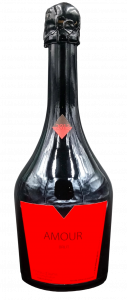
The cuvée Amour is a rare glimpse into sparkling reds of the Loire, only produced in the best 2 or 3 vintages of each decade. Pineau d’Aunis comes into its own, revealing brilliant spiced and delicately perfumed notes after both 6 months of oak age...